
How to Choose an FM Broadcast Transmitter for a Radio Station?
Choosing the right FM broadcast transmitter is about more than selecting an output power. A reliable broadcast system also depends on coverage requirements, antenna height, feeder-cable loss, audio performance, protection features, local regulations, and long-term technical support.
This guide explains how radio stations and broadcast system integrators can compare FM transmitters and select equipment that fits their requirements.
1. Define Your Broadcasting Requirements
Before comparing FM broadcast transmitters, define the purpose of your station and the area you need to cover. The right solution for a community radio station may be different from the right solution for a regional broadcaster.
Start with these questions:
- Coverage area: What towns, communities, or regions do you need to reach?
- Transmitter-site elevation: Is the antenna installed on a tower, rooftop, hill, or other elevated location?
- Terrain: Does the coverage area include mountains, dense buildings, or open farmland?
- Operating hours: Will the station operate continuously, 24 hours a day?
- Existing equipment: Do you already have an antenna, coaxial feeder cable, audio processor, or studio link?
- Licensing requirements: What frequencies, output power, and effective radiated power (ERP) are permitted in your target market?
These details help narrow the appropriate transmitter power and avoid choosing equipment that does not match your project.
2. Choose the Right FM Transmitter Power
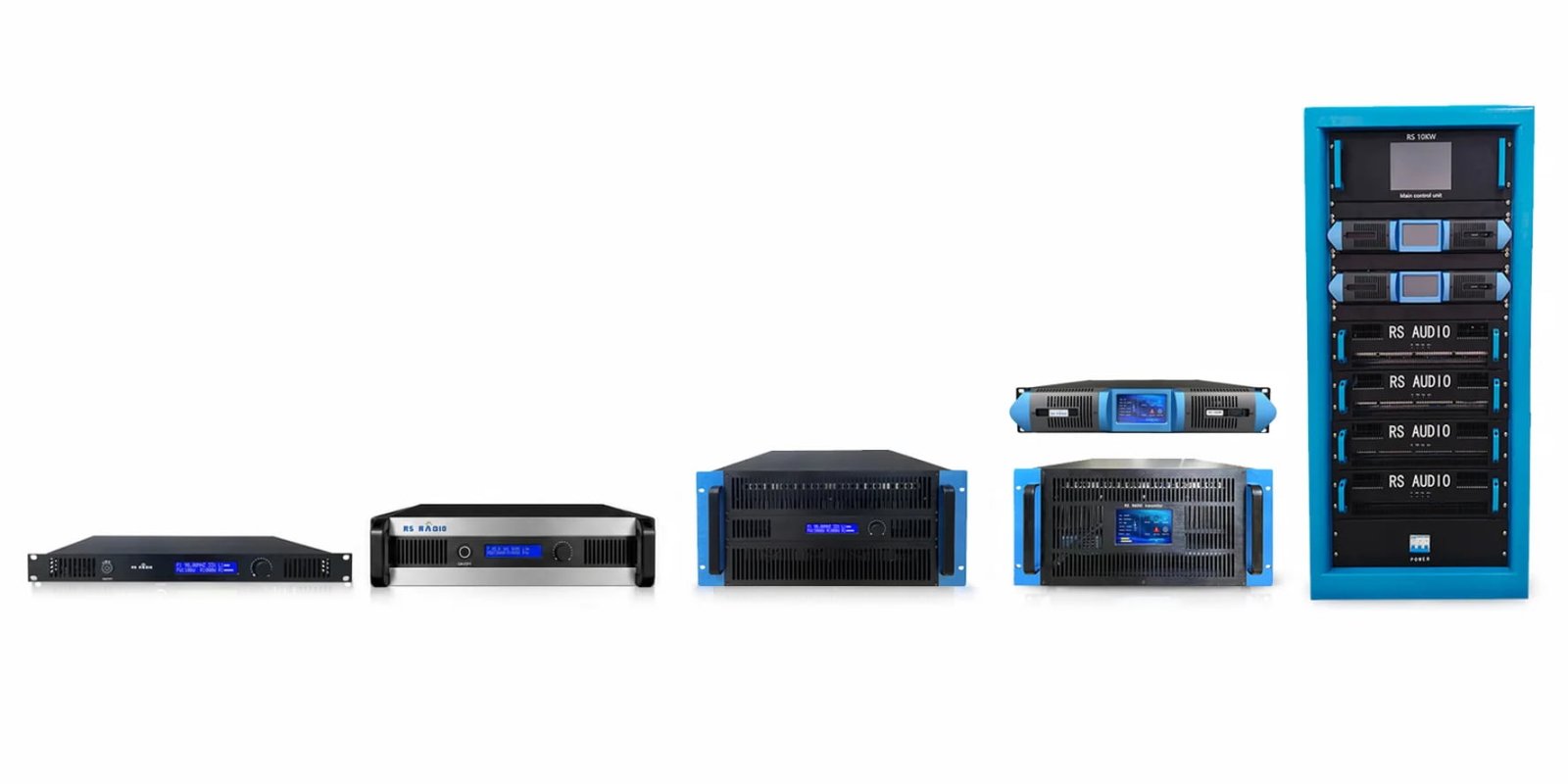
FM broadcast transmitters are available at different output power levels. The appropriate model depends on the required coverage, antenna system, installation site, and local authorization—not transmitter wattage alone.
| Transmitter Power | Approximate Reference Coverage Range |
|---|---|
| 15W | 1–3 km |
| 50W | 3–5 km |
| 100W | 7–12 km |
| 300W | 15–20 km |
| 500W | 20–25 km |
| 1kW | 25–30 km |
| 1.5kW | 25–38 km |
| 2kW | 30–60 km |
| 3kW | 40–70 km |
| 5kW | 60–80 km |
These figures are RS-Radio’s reference coverage ranges for initial planning, not guaranteed results. Actual coverage depends on antenna height, terrain, antenna gain, feeder-cable loss, interference, and receiver performance.
Low-Power FM Transmitters
Low-power FM transmitters can suit small community radio stations and other limited-area broadcasting projects where permitted. Before choosing a model, confirm the required service area and local licensing rules.
Medium-Power FM Transmitters
Medium-power transmitters are suitable for many community and local commercial radio projects. Buyers should compare frequency stability, audio quality, cooling, protection features, and technical support.
High-Power FM Transmitters
High-power FM transmitters are designed for larger broadcasting projects. These installations require careful planning for the electrical supply, cooling, antenna system, feeder cable, grounding, and lightning protection.
3. Understand FM Transmitter Coverage Range
Transmitter output power alone cannot determine how far an FM broadcast signal will travel. Several factors affect the usable coverage area.
- Antenna height: Higher antennas can improve line-of-sight coverage.
- Terrain: Mountains, buildings, and other obstacles can weaken signals or create coverage gaps.
- Antenna gain: Antenna gain and radiation pattern affect how RF energy is distributed.
- Feeder-cable loss: Cable and connector losses reduce the power delivered to the antenna.
- Interference: Other stations operating on nearby frequencies can affect reception.
- Receiver performance: Different radios may receive the same signal at different distances.
For reliable planning, use a coverage-prediction method that accounts for terrain and required signal strength. Field testing can also help confirm performance at the intended site.
4. Compare the Technical Specifications
Two FM broadcast transmitters with the same rated output power may differ in audio quality, frequency stability, protection, and monitoring capabilities.
Frequency Range and Stability
Many broadcast transmitters support the 87.5–108 MHz FM band, although the permitted frequency range varies by country. Confirm that the transmitter supports the frequencies authorized for your station.
A PLL-based frequency-control system helps maintain the selected carrier frequency.
Audio Inputs and Stereo Performance
Check that the transmitter is compatible with your studio and audio-processing equipment. Depending on the model, available interfaces may include balanced audio inputs, unbalanced audio inputs, or MPX input.
If stereo broadcasting is required, compare the stereo encoder specifications and published audio-performance data.
Protection Features
Useful protection functions may include:
- Over-temperature protection
- High-VSWR or reflected-power protection
- Over-current protection
- Adjustable RF output power
- Fan-failure alarms
Confirm which features are included in the specific model you plan to purchase.
Remote Monitoring
Remote monitoring can help operators check transmitter status and identify faults at unattended sites. Verify whether the model supports network control, alarm reporting, or other remote functions before ordering.
Power Supply and Cooling
Confirm the required AC input voltage and power-supply configuration. For stations that operate continuously, also review cooling requirements, ventilation, and maintenance procedures.
5. Select a Compatible Antenna and Feeder Cable
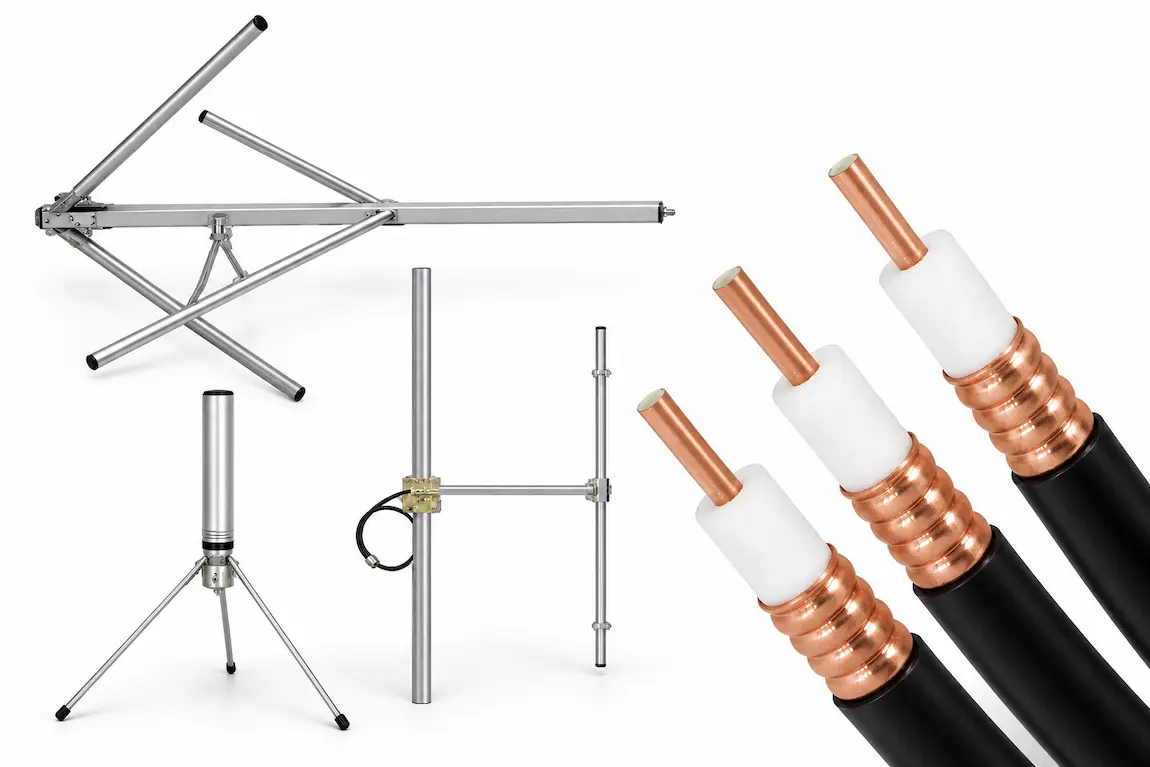
The antenna and feeder cable are important parts of the FM broadcasting system. Their specifications affect effective radiated power, signal distribution, and overall system performance.
Antenna Selection
Common options include:
- Dipole antennas: Commonly used in FM broadcast installations.
- Multi-bay dipole arrays: Can provide additional gain and shape the vertical radiation pattern.
- Directional antennas: Useful when coverage needs to be concentrated in particular directions.
The appropriate antenna depends on the installation site, coverage target, polarization requirements, and local regulations.
Feeder-Cable Selection
Cable loss depends on frequency, cable type, length, connectors, and installation quality. Larger, suitable low-loss feeder cables generally have lower attenuation than smaller cables.
When choosing a cable:
- Keep the feeder run as short as practical.
- Check the manufacturer’s cable-loss specifications at your operating frequency.
- Use connectors rated for the intended RF power.
- Weatherproof outdoor connections.
- Measure the installed system’s VSWR before putting it into operation.
- Provide suitable grounding and lightning protection.
A VSWR of 1.5:1 or lower is a common practical target, provided it is consistent with the transmitter and antenna specifications.
Understanding ERP
Effective radiated power (ERP) accounts for transmitter output, feeder losses, and antenna gain relative to a reference antenna.
When antenna gain is expressed in dBd, a simplified calculation is:
ERP (W) ≈ Transmitter Output (W) × 10^((Antenna Gain in dBd − Feeder Loss in dB) / 10)
For example, a 1,000W transmitter with an antenna gain of 3 dBd and feeder loss of 1 dB produces an approximate ERP of:
1,000 × 10^((3 − 1) / 10) ≈ 1,585W ERP
This simplified calculation does not replace a complete engineering assessment. Confirm whether local regulations specify limits in transmitter output power, ERP, or another measure.
6. Check Frequency Requirements and Local Regulations
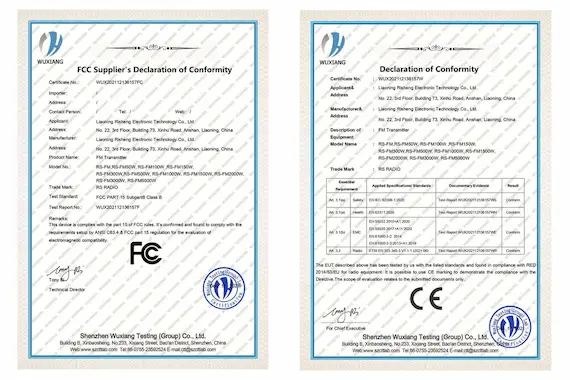
FM broadcasting is regulated differently across countries. Before purchasing or installing equipment, confirm the requirements with the relevant national or regional authority.
Check:
- Whether a broadcasting licence is required.
- Which frequencies are assigned or available for the station.
- The permitted transmitter output and ERP.
- Any limits on antenna height, site location, modulation, and occupied bandwidth.
- Applicable equipment approval and conformity requirements.
Do not assume that a frequency is available simply because it sounds clear on a receiver. A professional frequency assignment or interference assessment may be necessary, particularly in areas with many stations.
Equipment conformity marks or documents do not replace a broadcasting licence or authorization to transmit.
7. Evaluate Reliability, Protection, and Quality Control
Specifications should be supported by clear documentation and a credible quality-control process.
Before choosing a supplier, ask:
- Test records: Can the manufacturer provide model-specific output-power and functional test information?
- Protection: Which protections are built into the selected model, and what happens when a limit is reached?
- Components: Are fans, power supplies, and other serviceable components accessible for maintenance?
- Documentation: Are the user manual, installation instructions, wiring information, and troubleshooting guidance available?
- Compliance documents: Can the supplier provide applicable test reports or certificates for the exact model and target market?
- Technical support: Can you contact someone who understands RF systems and can help troubleshoot installation issues?
If a supplier advertises a specific certification, test period, protection temperature, or failure rate, ask for supporting documentation and confirm that the claim applies to the model you plan to purchase.
8. Compare Warranty and After-Sales Support
A transmitter may be expected to operate for long periods, so support arrangements matter as much as the initial purchase price.
Before ordering, clarify:
- Warranty period: How long is the warranty, and when does it begin?
- Coverage and exclusions: Which parts and failure types are covered?
- Repair process: Does the supplier provide remote troubleshooting, repair guidance, replacement parts, or a return-for-service option?
- Response time: What response time can the supplier reasonably provide, and in which languages?
- Installation support: Are manuals, diagrams, setup instructions, or operating videos available?
- Spare parts: Which parts should be kept on site, especially for remote transmitter locations?
- Shipping and duties: Who pays for shipping, customs charges, and return transport in a warranty case?
RS-Radio offers a five-year warranty according to its stated product policy. Confirm the current warranty terms and clearly explain any exclusions that apply to particular components before publishing this claim.
9. Calculate the Total System Cost
The transmitter price is only one part of a broadcast installation. Build a budget that includes:
- FM broadcast transmitter
- Antenna and any required power divider
- Coaxial feeder cable, connectors, and installation accessories
- Mast or tower, mounting hardware, grounding, and lightning protection
- Audio processor, stereo encoder, studio link, or monitoring equipment where required
- Electrical installation, ventilation, and site preparation
- Shipping, import duties, and local taxes
- Maintenance, spare parts, and electricity over the expected operating life
A complete kit may simplify purchasing, but compare the exact components included. A lower package price is not necessarily better value if the antenna, feeder, or connectors are unsuitable for the intended power level.
If future expansion is likely, discuss the upgrade path before ordering. Confirm whether the transmitter can be upgraded, whether the antenna system can support the planned output, and whether the electrical supply and feeder are adequately sized.
Frequently Asked Questions
What power FM transmitter do I need for my radio station?
The required power depends on the coverage target, antenna height, terrain, antenna gain, feeder loss, interference, and local licensing limits. Share these details with a qualified broadcast-system supplier to narrow down the appropriate models.
How far can an FM broadcast transmitter reach?
There is no single range for a given wattage. A transmitter’s usable coverage depends on the complete antenna system, terrain, site elevation, interference, and the receiver. Treat published coverage ranges as planning references, not guarantees.
Is a higher-power FM transmitter always better?
No. Higher output power may help meet a coverage requirement, but it does not solve every problem. Antenna height, antenna pattern, feeder loss, frequency coordination, and the permitted ERP can be equally important.
What equipment is needed for an FM broadcast station?
A typical system includes an FM broadcast transmitter, a compatible antenna, coaxial feeder cable, connectors, and suitable grounding and lightning protection. Depending on the station design, it may also need audio processing, a stereo encoder, studio-to-transmitter links, monitoring equipment, and a tower or mast.
Why is VSWR important?
VSWR indicates how well the RF system is matched. A high VSWR can indicate a problem with the antenna, feeder, connectors, or installation. Follow the transmitter’s operating limits and measure the installed system before putting it into service.
What should I ask an FM transmitter manufacturer before buying?
Ask about the exact model’s output power, frequency range, audio interfaces, protection functions, cooling, power requirements, test documentation, compliance documents, warranty conditions, spare parts, and technical support. Also provide your coverage target and antenna-site details so the supplier can make a more relevant recommendation.
Related Articles
How far will a 50 watt FM transmitter reach?
Under normal conditions, a 50 watt FM transmitter can cover approximately 3–5 km (2–3 miles). Under ideal conditions,...
Read moreHow far will a 1000 watt FM transmitter reach?
Under normal conditions, a 1000 watt FM transmitter can cover approximately 25–30 km (16–19 miles). Under ideal conditions,...
Read more