
Buyer's Guide
6 Things to Check Before Buying a Low Power FM Transmitter for a Drive-In Theater
A drive-in theater depends on a low power FM transmitter to carry the movie's audio to every car in the lot. Before choosing a unit, it helps to understand a few technical points that determine whether the setup will actually work as expected once it's installed.
Match transmitter power to the size of your lot
Broadcast distance is directly tied to output power: a higher power transmitter reaches farther, while a lower power unit is enough for a small lot. Before buying, estimate the radius your parking area covers and compare it against a power-to-distance reference. Buying on wattage alone, without checking a coverage chart, can leave the back rows without signal -- or leave you paying for more power than a small venue needs.
Actual coverage also depends on antenna height, antenna gain, cable loss, and local terrain, so treat the figures below as a starting reference rather than a guarantee.
| Transmitter Power | Estimated Coverage Radius* | Typical Setting |
|---|---|---|
| 15W - 30W | 1 - 3 km | Small lot, single-screen test setup |
| 50W - 100W | 3 - 12 km | Small to medium drive-in |
| 150W - 300W | 12 - 20 km | Medium drive-in, larger parking area |
| 500W - 1KW | 20 - 30 km | Large lot or multi-area coverage |
*Figures assume a properly matched antenna and cable, reasonable antenna height, and flat, open terrain.
See How Far Can an FM Radio Transmitter Reach?Confirm the available FM frequency range
FM broadcast transmitters typically tune across the 87.5 - 108 MHz band, the standard range receivable by car radios. Before buying, confirm the exact tuning range and step size the unit supports, and check that it lets you select a clear, unused frequency in your area to avoid overlapping with existing local FM stations.
Read more on How to find a free FM frequencies for FM radio transmitters?Consider the total cost of your FM broadcasting setup
When buying an FM transmitter, it is worth considering the cost of the complete setup rather than looking at the transmitter price alone. Depending on your project, you may also need an FM antenna , coaxial cable , audio equipment, or other broadcasting accessories.

- FM transmitter -- the core equipment that generates and modulates the broadcast signal.
- Antenna and coaxial cable -- required when building or expanding the RF transmission system, with antenna selection and cable quality affecting signal performance.
- Audio and broadcast equipment -- such as mixers, audio processors, microphones, or monitoring equipment, depending on the needs of your station.
If you only need a transmitter, a standalone unit may be the simplest option. For customers building a complete FM system, an FM transmitter package can combine the main RF equipment and accessories into one setup. Larger projects may also require additional broadcast equipment. Comparing the total setup cost in advance can help you choose the equipment you actually need without paying for unnecessary components.
Pay attention to audio quality
Since the transmitter carries the entire movie soundtrack, its audio circuitry matters as much as its power output. Check the specified frequency response and signal-to-noise ratio, and whether the unit supports stereo input, since most film audio tracks are recorded in stereo.
Also confirm what audio input connections are available (RCA, 3.5mm, or balanced XLR) so the transmitter can connect directly to the projector or media player without needing an extra converter. Weak input handling or a low signal-to-noise rating tends to show up as background hiss or muddy sound on car radios, even when the signal strength itself is adequate.
Look for simple and reliable operation
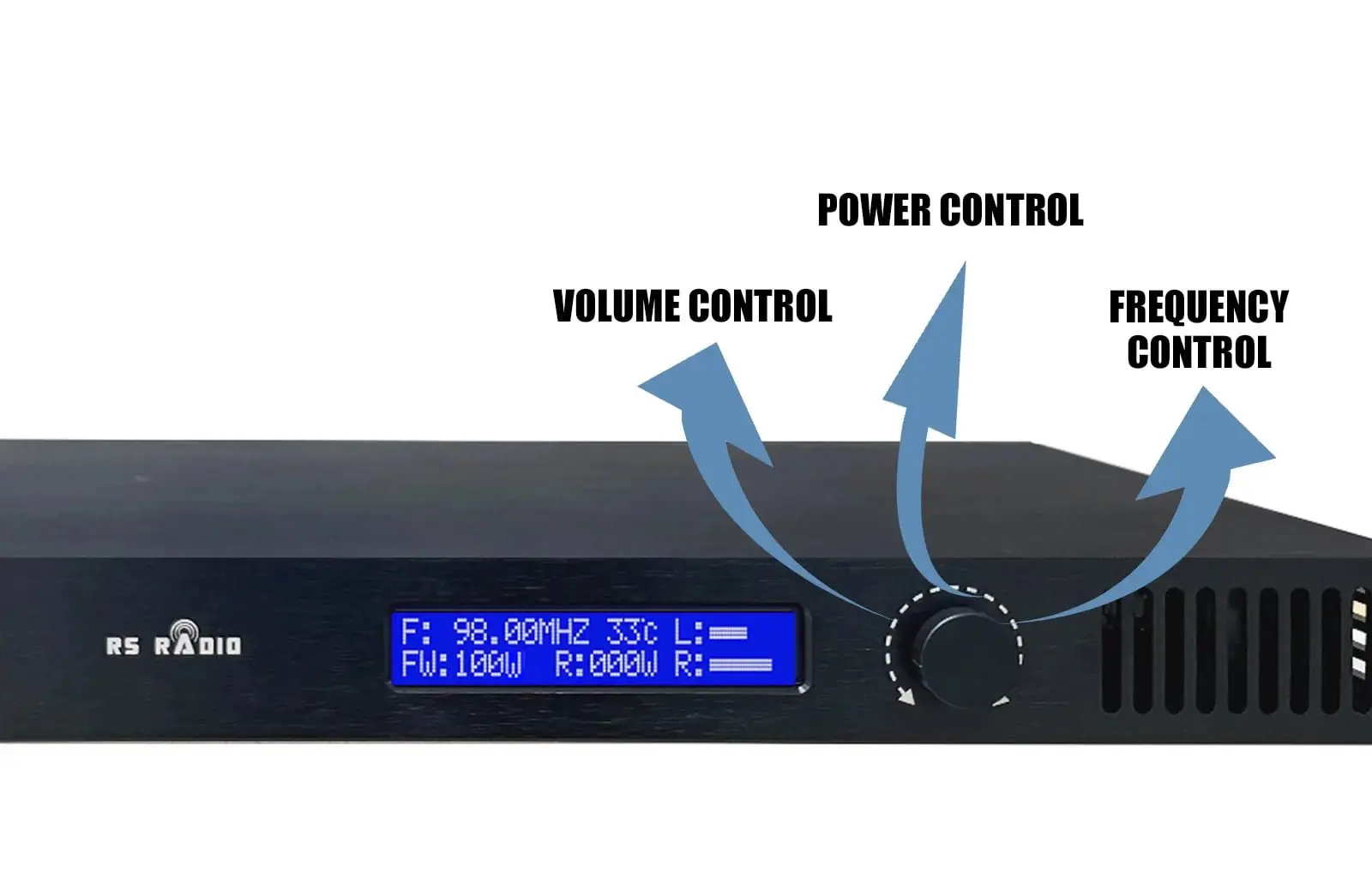
Drive-in theater staff are not always trained radio engineers, so day-to-day operation should be straightforward. Look for a clear frequency display, simple controls for adjusting audio level and frequency, and -- on some models -- a touchscreen interface that shows the current status at a glance.
Reliability matters just as much as ease of use: a unit that needs to run for two to three hours continuously during a screening should be built for sustained operation, not just short test bursts. Ask whether the model you're considering is rated for continuous duty cycles.
Check protection and monitoring functions
Transmitters generate heat during continuous operation, so a built-in over-temperature protection circuit is worth checking for. It typically shuts the unit down or reduces output automatically once internal temperature reaches a set threshold -- commonly around 60°C -- to prevent component damage during long outdoor screenings.
Also look for basic monitoring indicators: forward/reflected power (VSWR) readouts help confirm the antenna and cable are properly matched, and a fault or status LED can flag a problem before it causes a full signal outage in the middle of a screening.
These protection features don't prevent every failure, but they reduce the chance of the transmitter shutting down without warning during a live event, and they make it easier to diagnose a problem if one does occur.