
Top 8 Power and Coverage Myths About FM Radio Stations
FM Broadcasting Basics
Ask ten people what determines how far an FM station reaches and most will answer, "the transmitter power." That answer is only partly right. Coverage depends on the whole transmission chain, the site, the terrain and the listener’s receiver. This guide corrects the eight most common misconceptions about FM transmitter power and coverage range.
Myth 1: More Power Always Means Proportionally More Range
The reality: Higher power does extend range, but not in a straight line. In ideal free-space conditions, field strength falls in proportion to distance, and it rises with the square root of power. To double the distance at the same signal level, you need roughly four times the power. Doubling the power gives only about 1.4 times the distance.
Real-world conditions are usually less forgiving than free space, so the gains from extra power are often smaller than expected. Going from 500 W to 1 kW is a modest improvement. Raising the antenna or improving its placement can give a bigger one.
Illustrative power-to-range ranges (open terrain, elevated antenna, typical receivers)
| Transmitter power | Typical radius |
|---|---|
| 30-100 W | About 2-10 km |
| 300-500 W | About 8-25 km |
| 1-2 kW | About 15-40 km |
| 3-5 kW | About 25-60 km |
These ranges are general estimates only. Terrain, antenna height and gain, cable loss, local noise and the receiver all change the outcome.
Myth 2: The Transmitter Is the Only Equipment That Matters
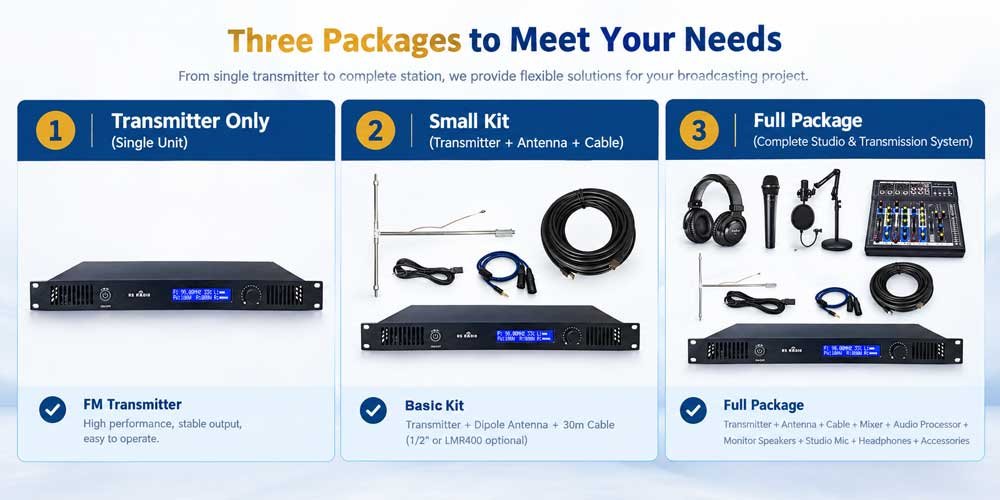
The reality: The transmitter generates the signal, but the cable carries it and the antenna radiates it. A powerful transmitter connected to a poor antenna or a lossy cable can perform worse than a modest transmitter with a well-designed system.
When planning a station, budget for all three parts together. Many new broadcasters spend most of their budget on the transmitter and then settle for whatever antenna and cable are cheapest.
Myth 3: Antenna Height Matters Less Than Power
The reality: At FM frequencies the signal behaves largely like line-of-sight. The radio horizon grows with the square root of antenna height. A common rule of thumb for the distance to the horizon is about 4.12 × √h kilometres, where h is the height in metres. That puts the horizon at roughly 13 km for a 10 m antenna and about 41 km for a 100 m antenna.
Raising an antenna above nearby buildings and trees often improves coverage more than adding power. A well-placed 300 W system can sometimes outperform a 1 kW system installed too low.
Myth 4: Any Cable Will Do
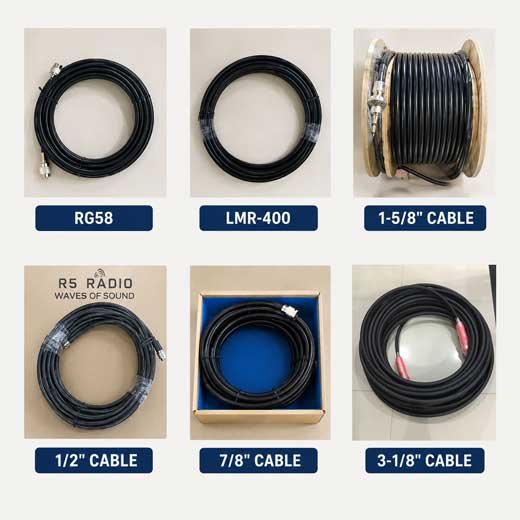
The reality: Coaxial cable always loses some power as heat. The loss grows with cable length and frequency, and it varies a lot between cable types and quality grades. Every 3 dB of loss means half of your power never reaches the antenna. A 10 dB loss wastes about 90%.
On a tall tower with a long cable run, thin or low-quality cable can undo much of the benefit of a more powerful transmitter. Choose a cable rated for the power level and the run length. Use good-quality connectors, and seal outdoor joints against moisture.
Myth 5: A High-Gain Antenna Creates Extra Power
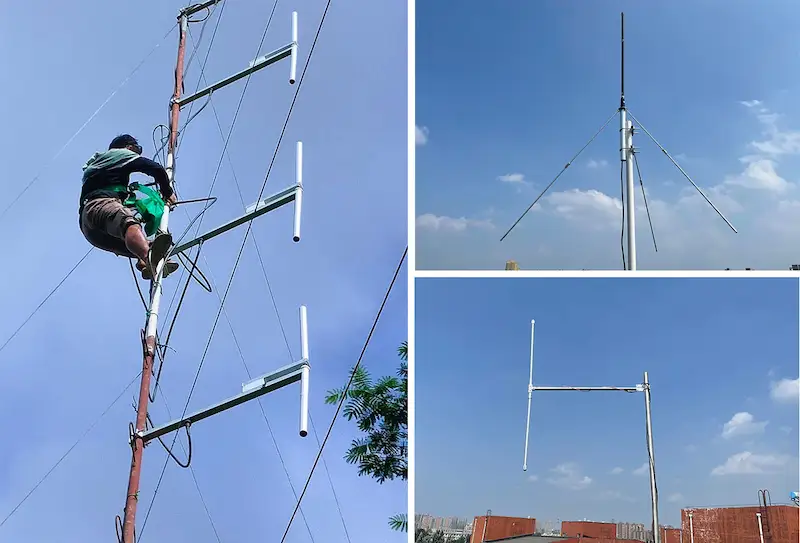
The reality: An antenna is a passive device and cannot create energy. Gain means the antenna focuses the available power in preferred directions, usually by narrowing the vertical beam toward the horizon. The result is a higher effective radiated power (ERP) in the direction that matters.
Gain has trade-offs. Stacking more antenna elements increases gain, but it also adds size, weight, wind load and cost. A narrow vertical beam can leave weak spots very close to a tall tower. For stations in hilly areas, beam tilt and pattern shape matter as well.
Myth 6: FM Signals Pass Through Hills and Buildings Easily
The reality: FM signals between 87.5 and 108 MHz can bend slightly around obstacles and pass through some materials. Large hills, dense urban structures, metal-clad buildings and thick forest still absorb, reflect or block them. Behind a ridge, the signal can drop sharply even if the receiver is within the "rated" distance.
This is why broadcasters survey the area before choosing a site. A hilltop or tall building usually serves better than a valley location, even with identical equipment. Coverage is rarely a perfect circle. Terrain shapes it into an irregular footprint.
Myth 7: Antenna Matching Is a Minor Detail
The reality: If the antenna and cable are not well matched to the transmitter output, part of the power is reflected back instead of radiated. This is measured as VSWR (voltage standing wave ratio). A high VSWR reduces the radiated power and stresses the transmitter’s output stage. Many transmitters therefore include protection that cuts output power automatically when reflections or temperatures are too high.
Tune the antenna to the operating frequency, check VSWR after installation, and inspect connectors periodically. Adequate ventilation also matters, because heat is one of the most common causes of reduced output in continuous operation.
Myth 8: Quoted Coverage Figures Are Guaranteed
The reality: A power-to-distance table is a planning guide, not a promise. Any figure assumes certain conditions, such as antenna height, terrain, the minimum signal level at the receiver, and the amount of background noise and interference. A car radio with an external antenna, a cheap indoor receiver and a portable radio will all pick up the same signal differently.
Your chosen frequency matters too. In a crowded band, a strong neighbouring station on or near your channel can reduce your usable range, regardless of your own power. Scan the band for the cleanest frequency before you go on air. Also check the licensing and power limits in your country. These rules differ widely and may cap the power you can legally use.
A Practical Checklist for Better Coverage
- Define the target coverage area and survey the terrain first.
- Install the antenna as high and as clear of obstructions as practical.
- Choose a low-loss cable suited to the run length and power level.
- Select an antenna with a pattern suited to your area, not just the highest gain.
- Check VSWR, and keep the transmitter cool and ventilated.
- Pick a clean frequency within 87.5-108 MHz and stay within local regulations.
- Test reception with several receiver types before drawing conclusions.
Frequently Asked Questions
How far can a 100 W FM transmitter reach?
With an elevated antenna and open terrain, a 100 W system often covers roughly 5-10 km. In built-up or hilly areas, the radius can be much smaller.
What do I need to start an FM station?
At minimum you need a transmitter, a matched antenna and a suitable coaxial cable. You also need an audio source and any licence required in your country.
Is it better to increase power or antenna height?
In many cases, raising the antenna and reducing cable loss gives more benefit per unit of cost than raising power. The best answer depends on your site, so evaluate both.
Conclusion
FM coverage is a system-level result. Transmitter power is one important factor among several, alongside antenna height and gain, cable quality, impedance matching, terrain and frequency selection. Understanding these myths helps you set realistic expectations and spend your budget where it makes the most difference.
When comparing equipment, ask suppliers for clear technical specifications and a power-to-distance reference. Manufacturers such as RS RADIO publish this kind of reference information for their FM transmitters. Whichever supplier you choose, treat any quoted range as a starting point, and confirm it with a site survey and on-air testing.
Related Articles
High Power FM Transmitter: Everything You Need to Know
High Power FM Transmitter: Everything You Need to Know I work as broadcast engineer at RS Electronics for...
Read more
Common Mistakes When Installing FM Transmitters
Common Mistakes When Installing FM Transmitters I work as installation engineer at RS Electronics for nine years installing...
Read more
8 Best FM Transmitter Packages for Turnkey Radio Stations
8 Best FM Transmitter Packages for Turnkey Radio Stations I work as broadcast systems engineer at RS Electronics...
Read more